
I remember sitting at my desk on a Sunday evening, scrolling through my bank account and feeling that familiar knot in my stomach. The monthly bills were coming, and my regular paycheck just wasn’t cutting it anymore. Maybe you’re feeling the same way right now.
Here’s the truth I wish someone had told me years ago: side hustles aren’t about getting rich overnight or finding some secret money-making trick. They’re about learning skills, building something real, and creating genuine value for others. When you do that, the money follows naturally.
In this guide, I’m going to walk you through everything you need to know about starting side hustles as a complete beginner. We’ll cover the easiest options to start with, how much time you’ll actually need, and most importantly, how to avoid the common mistakes that trip up most people in their first few months.

Contents
- 1 What Are Side Hustles for Beginners?
- 2 How Side Hustles Work for People with Full-Time Jobs
- 3 Can You Start a Side Hustle with No Money or Experience?
- 4 Best Side Hustles for Beginners in 2026
- 5 How to Choose the Right Side Hustle for Your Skills
- 6 Skills You Actually Need for Popular Side Hustles
- 7 How Much Time Does a Side Hustle Really Take Each Week?
- 8 Are Side Hustles Taxable Income? (Yes, Here’s What You Need to Know)
- 9 Common Mistakes Beginners Make with Side Hustles (And How to Avoid Them)
- 10 Can Side Hustles Turn Into Full-Time Careers?
- 11 Free Resources to Help You Learn Side Hustle Basics
- 12 How to Fit Side Hustles Into a Busy Schedule
- 13 How Beginners Organize Multiple Side Hustles (If You Go That Route)
- 14 How to Build Skills for Side Hustles That Create Long-Term Value
- 15 The Reality Check: What to Expect in Your First 90 Days
- 16 Final Thoughts: Your Side Hustle Journey Starts with One Step
What Are Side Hustles for Beginners?
Side hustles are flexible ways to earn extra income outside your main job. Unlike traditional part-time work with fixed schedules, side hustles let you work on your own terms—early mornings, late evenings, or weekends.
For beginners, the best side hustles share three key characteristics:
- Low or no startup costs – you shouldn’t need hundreds of dollars to get started
- Skills you can learn quickly – within a few weeks, not years
- Flexible time commitment – you control when and how much you work
Think of side hustles as skill-building opportunities that also pay. Every hour you invest teaches you something new—whether it’s how to communicate with clients, manage your time better, or market your services.
How Side Hustles Work for People with Full-Time Jobs
Working a full-time job doesn’t mean you can’t build a successful side hustle. The key is finding the right fit for your schedule and energy levels.
Most people with day jobs dedicate 5-10 hours per week to their side hustle. That might sound like a lot, but it breaks down to about 1-2 hours on weekday evenings and a few hours on weekends. The beauty of many online side hustles is that you can work in small chunks—30 minutes here, an hour there.
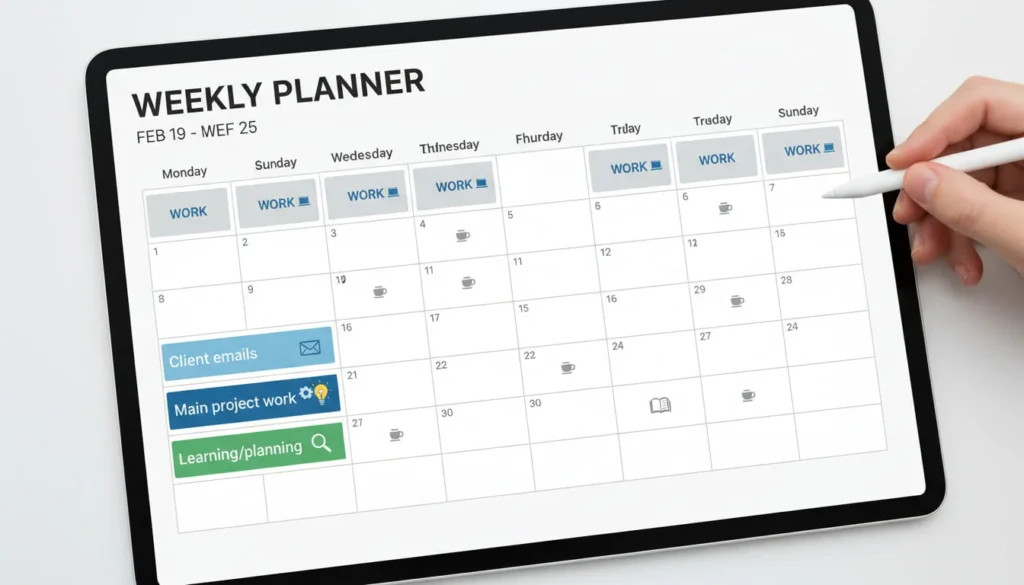
Here’s what a realistic week might look like:
- Monday & Wednesday evenings: 1 hour each (client communication, small tasks)
- Saturday morning: 3-4 hours (focused work on main projects)
- Sunday afternoon: 2 hours (planning, learning new skills)
The secret is protecting your energy. Choose evening side hustles that don’t drain you after your day job. If you’re mentally exhausted from meetings all day, maybe data entry isn’t the best choice. Instead, consider something more creative or hands-on that uses different mental muscles.
Can You Start a Side Hustle with No Money or Experience?
Absolutely yes. Some of the most profitable side hustles require nothing more than a laptop, internet connection, and willingness to learn.
When I started freelance writing, I had zero professional experience. But I did have decent grammar and the ability to research topics thoroughly. That was enough to land my first few small projects. Each project taught me something new, and within three months, I was earning consistent side income.
Easy side hustles from home with no investment include:
- Content writing – companies always need blog posts, product descriptions, and website copy
- Virtual assistance – help businesses with emails, scheduling, and basic admin tasks
- Social media management – manage accounts for small businesses in your area
- Online tutoring – teach subjects you already know well
- Transcription – convert audio files to text (just need good listening skills)
The catch? You need to invest time in learning. Spend your first week watching free YouTube tutorials, reading blog posts (like this one!), and practicing your chosen skill. The investment is time, not money.
Best Side Hustles for Beginners in 2026
Let’s get into specific side hustle ideas that work well for people just starting out. I’ve focused on options that don’t require specialized degrees or years of experience.
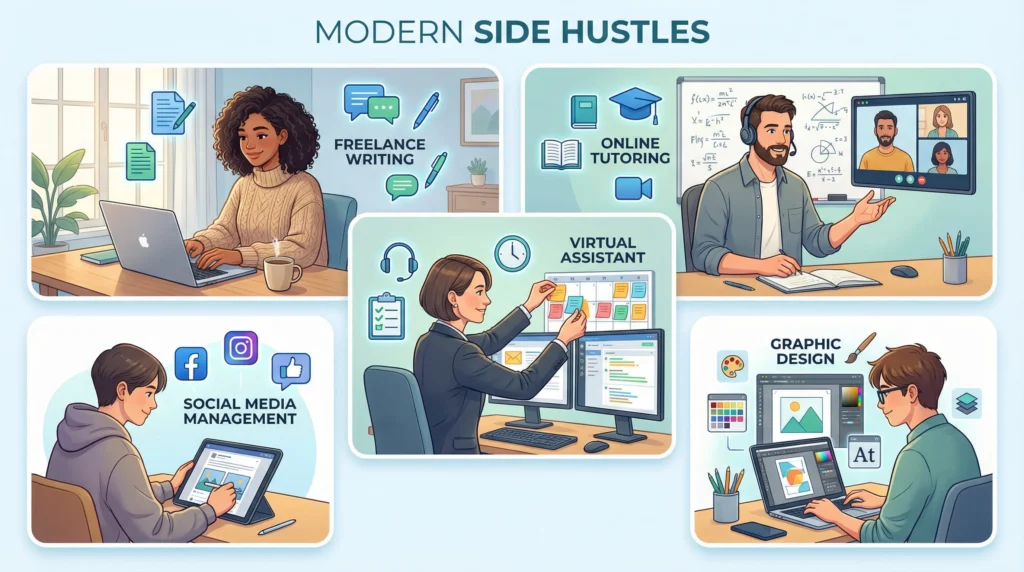
Freelance Writing
If you can write clear, helpful content, businesses will pay you for it. Every company needs website content, blog posts, email newsletters, and social media captions. You don’t need to be a literary genius—you just need to communicate ideas clearly.
Getting started: Create samples by writing 2-3 blog posts on topics you know well. Set up a free profile on Upwork or Fiverr. Start with smaller projects to build reviews and experience.
Time investment: 5-10 hours per week initially, can scale up as you get faster
Realistic earnings: $15-30 per hour as a beginner, $50-100+ per hour with experience
Virtual Assistant Services
Virtual assistants handle administrative tasks remotely—managing emails, scheduling appointments, data entry, customer service, and basic research. If you’re organized and detail-oriented, this is a great fit.
Getting started: List your organizational skills and any software you know (Google Workspace, Microsoft Office, project management tools). Join VA-specific job platforms like Belay or Time Etc.
Time investment: Flexible, from 5 hours to 20+ hours per week
Realistic earnings: $12-25 per hour for general tasks, more for specialized skills
Online Tutoring
Share knowledge you already have. Whether it’s English, math, science, or even music, there are students worldwide who need help. Platforms like VIPKid, Chegg Tutors, and Wyzant connect tutors with students.
Getting started: Identify subjects you’re confident teaching. Most platforms require a video introduction and subject verification. Some prefer teaching certifications, but many accept demonstrated knowledge.
Time investment: As little as 3-5 hours per week, schedule your own sessions
Realistic earnings: $15-40 per hour depending on subject and experience
Social Media Management for Small Businesses
Small local businesses often need help managing their Facebook, Instagram, or LinkedIn accounts but can’t afford a full-time employee. If you understand social platforms and can create engaging posts, this is a natural fit.
Getting started: Practice by managing your own social accounts or volunteer for a local nonprofit. Build a simple portfolio showing post examples. Reach out to small businesses in your area.
Time investment: 5-8 hours per client per week
Realistic earnings: $300-800 per month per client
Graphic Design Using Templates (No Design Degree Needed)
Tools like Canva make it possible to create professional-looking graphics without being a trained designer. Small businesses need social media graphics, flyers, presentations, and simple logos.
Getting started: Learn Canva basics (takes a weekend). Create sample graphics for different industries. Offer your services on Fiverr or directly to local businesses.
Time investment: 3-6 hours per week for beginners
Realistic earnings: $10-50 per design as a beginner, packages of $200-500+ with experience
Side Hustle Comparison Table
| Side Hustle | Time to Start | Beginner Rate | Startup Cost |
|---|---|---|---|
| Freelance Writing | 1-2 weeks | $15-30/hour | $0 |
| Virtual Assistant | 1 week | $12-25/hour | $0 |
| Online Tutoring | 1-2 weeks | $15-40/hour | $0 |
| Social Media Management | 2-3 weeks | $300-800/client/mo | $0 |
| Graphic Design (Canva) | 3-5 days | $10-50/design | $0-13/month (Canva Pro) |
How to Choose the Right Side Hustle for Your Skills
The best side hustle for you isn’t necessarily the most profitable one—it’s the one that matches your current skills, available time, and learning style.
Ask yourself these questions:
- What am I already decent at? Writing? Organization? Explaining concepts? Teaching? Design sense?
- How much time can I realistically commit? Be honest. If you only have 4-5 hours per week, choose something with a quick learning curve.
- Do I prefer working with people or independently? Tutoring involves direct interaction. Freelance writing can be mostly solo.
- What skills do I want to build? Choose a side hustle that develops abilities useful for your career goals.
Here’s a practical approach: Pick one side hustle that aligns with your answers above. Give it 30 days of consistent effort. If it’s not working out, you’ve only invested a month. If it clicks, double down and improve your skills.
Skills You Actually Need for Popular Side Hustles
Let me be straight with you—you don’t need expert-level skills to start. You need baseline competency and the willingness to improve as you go.
For writing:
- Clear communication (if people understand your texts and emails, you’re good)
- Basic grammar (tools like Grammarly can help)
- Research ability (knowing how to Google effectively)
For virtual assistant work:
- Organization and attention to detail
- Familiarity with basic software (email, calendar, document creation)
- Professional communication
For tutoring:
- Strong knowledge of your subject
- Patience and ability to explain concepts simply
- Basic tech skills for video calls
The good news? All these skills improve with practice. Your 50th client email will be better than your first. Your 10th blog post will be stronger than your initial attempt. That’s the whole point of side hustles that require no special skills—you build the skills as you earn.
How Much Time Does a Side Hustle Really Take Each Week?
This is where most guides lie to you. They’ll tell you that you can make thousands working just 2 hours per week. Let’s get real.
In your first month: Expect to spend 8-12 hours per week. About half of this is learning—watching tutorials, practicing skills, setting up profiles, figuring out how platforms work. The other half is actual paid work or finding clients.
After 2-3 months: You can typically maintain a side hustle with 5-8 hours per week if you’re earning $300-500 monthly. If you want to earn $1,000+ monthly, plan for 10-15 hours weekly.
After 6+ months: Your efficiency dramatically improves. Tasks that took you 2 hours now take 45 minutes. You have repeat clients, so less time is spent hunting for work. Many people at this stage earn $500-1,500 monthly working 8-12 hours per week.
Weekend side hustles for busy professionals work particularly well because you can batch your work. Spend Saturday morning completing the week’s tasks, then handle quick communications during weeknight evenings.
Are Side Hustles Taxable Income? (Yes, Here’s What You Need to Know)
Short answer: Yes, side hustle income is taxable. But don’t let this scare you—it’s straightforward once you understand the basics.
In most countries (US, UK, Canada, Australia), you need to report side hustle earnings as self-employment or freelance income. Here’s what this actually means in practice:
- Track all earnings: Use a simple spreadsheet or apps like QuickBooks Self-Employed, Wave (free), or FreshBooks
- Keep receipts for business expenses: Your laptop, internet bill, software subscriptions—these can often be deducted
- Set aside 20-30% for taxes: Not all of it will be taxed, but this buffer keeps you safe
- File appropriately: In the US, use Schedule C. In the UK, register as self-employed if earning over £1,000 annually
Pro tip: When you’re just starting out and earning under $500 monthly, keep it simple. A basic spreadsheet tracking dates, clients, amounts earned, and business expenses is enough. As you grow, consider a dedicated accounting app or tax software.
Common Mistakes Beginners Make with Side Hustles (And How to Avoid Them)
I’ve made every mistake in the book, and I’ve watched countless beginners make them too. Here are the big ones:
1. Underpricing their services
When you’re nervous about landing your first client, it’s tempting to charge $5 for something worth $50. Don’t. Even as a beginner, charge fair rates. If you’re writing a 500-word blog post, $20-30 is reasonable. If you’re managing social media for a month, $300 minimum. Remember: cheap prices attract difficult clients.
2. Trying to do everything at once
You see people talking about writing, graphic design, virtual assistance, and tutoring—and you think you should do all of them. No. Pick one. Get decent at it. Build some income. Then consider adding another.
3. Giving up too quickly
The first two weeks are tough. You send proposals that get ignored. You complete work that feels harder than it should. You wonder if you’re wasting your time. This is normal. Most successful side hustlers will tell you it took 4-6 weeks before things clicked. Stay motivated by setting micro-goals: send 5 proposals this week, complete 2 small projects, learn one new skill.
4. Not treating it like a real business
Just because you’re working from home in your pajamas doesn’t mean professionalism goes out the window. Respond to clients promptly. Meet deadlines. Communicate clearly. These habits separate the people who make $100 monthly from those who scale to $1,000+.
5. Neglecting to track their earnings
From day one, track what you earn and how long tasks take. This data is gold—it shows you which services are profitable and which clients are worth keeping. Use a simple spreadsheet or free tools like Toggl for time tracking.
Can Side Hustles Turn Into Full-Time Careers?
Absolutely, but it takes intentional scaling. Many people who start freelancing or running online businesses began as weekend side hustlers.
The transition typically looks like this:
- Months 1-3: Learning phase. Earning $100-400 monthly.
- Months 4-8: Building momentum. Earning $400-1,000 monthly with established clients.
- Months 9-12: Scaling phase. Earning $1,000-2,500 monthly by raising rates and getting better clients.
- Year 2: Decision point. Some people transition to full-time at $2,500-3,500 monthly if they have savings and a plan.
The key to scaling a side hustle over time is systematically improving three things: your skills (so you can charge more), your efficiency (so you earn more per hour), and your client quality (so you work with people who pay fairly and respect your time).
Most importantly, don’t quit your day job until your side hustle consistently earns 75-100% of your current salary for at least 3-6 months. You need that buffer because client work can be unpredictable.
Free Resources to Help You Learn Side Hustle Basics
You don’t need expensive courses to get started. Here are genuinely useful free resources:
For writing:
- HubSpot Academy (free writing courses)
- Grammarly Blog (grammar and style tips)
- r/freelancewriters on Reddit (community support)
For general freelancing:
- YouTube channels: Ali Abdaal, Thomas Frank, Freelance University
- Upwork’s Resource Center (even if you don’t use Upwork)
- r/sidehustle on Reddit (real experiences and advice)
For specific skills:
- Canva Design School (graphic design)
- Google Digital Garage (digital marketing basics)
- edX and Coursera (audit courses for free)
Free ways to practice side hustle skills include volunteering your services to nonprofits (builds portfolio and confidence), creating content for yourself (blog, social media, YouTube), and offering discounted rates to your first 2-3 clients in exchange for honest testimonials.
How to Fit Side Hustles Into a Busy Schedule
Time management is the real skill you’re developing with a side hustle. Here’s how to make it work when you already feel maxed out:
Use time blocking
Don’t just say “I’ll work on my side hustle when I have time.” Schedule specific blocks: Tuesday 7-8pm, Saturday 9am-12pm. Treat these blocks like important meetings you can’t miss.
Batch similar tasks
If you’re doing social media management, create all posts for the week in one sitting. If you’re writing, write multiple articles back-to-back. Context switching kills productivity.
Protect your deep work time
Some tasks need focused attention (writing, design work, learning new skills). Do these during your peak energy hours. Save administrative stuff (emails, invoicing, scheduling) for lower-energy times.
Build buffers into deadlines
If a client needs something by Friday, plan to finish by Wednesday. Life happens—unexpected overtime at work, family emergencies, exhaustion. Buffers save you from stress and missed deadlines.
Start smaller than you think you should
It’s better to commit to 5 solid hours per week that you actually do than to plan for 15 hours and constantly feel behind. You can always scale up.
How Beginners Organize Multiple Side Hustles (If You Go That Route)
I generally recommend starting with one side hustle, but if you decide to juggle multiple income streams, here’s how to stay sane:
Use a master calendar: Color-code different hustles. Block time for each. This visual overview prevents double-booking and helps you see if you’re overcommitted.
Separate income tracking: Track earnings from each hustle separately. This shows you which ones are actually worth your time. You might discover that 80% of your income comes from 20% of your activities.
Set priority levels: Decide which hustle is your main focus. When time gets tight, you know which one gets attention first. The others can flex or pause temporarily.
Automate where possible: Use scheduling tools for social media, template responses for common client questions, invoicing software that auto-sends reminders. Every automated task frees up mental energy.
Honestly though? Most people who successfully scale their side income pick one main hustle and maybe one complementary one. Spreading yourself across three or four rarely works well unless they’re extremely passive.
How to Build Skills for Side Hustles That Create Long-Term Value
This is where side hustles become more than just extra money—they become career builders. Every skill you develop compounds over time.
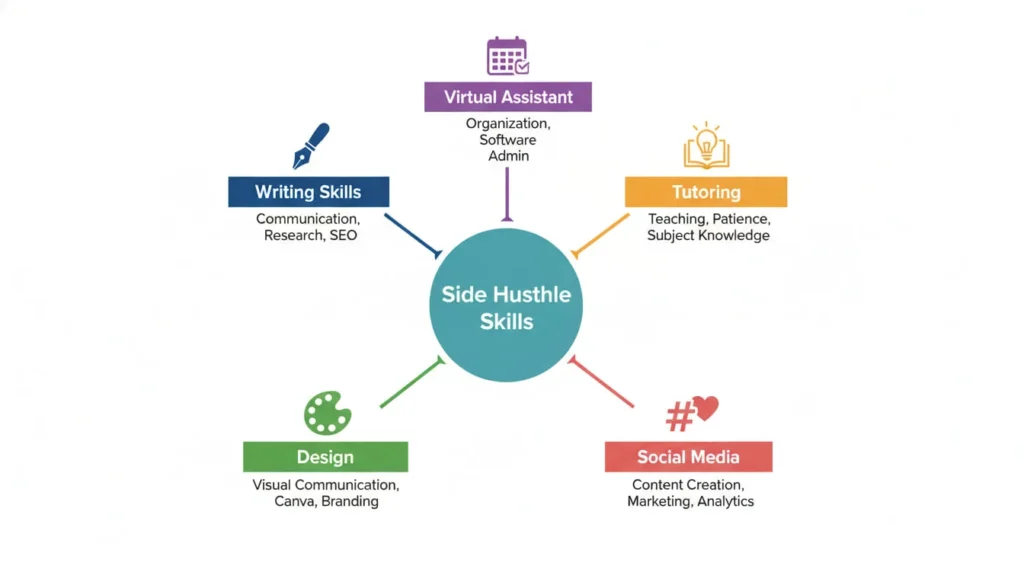
Side hustles that teach new skills include:
- Writing: Communication, research, persuasion, SEO
- Virtual assistance: Project management, organization, customer service, tech tools
- Social media management: Content creation, analytics, marketing strategy, visual design
- Tutoring: Teaching, patience, communication, subject mastery
- Graphic design: Visual communication, branding, software proficiency
The formula for skill building: Start with the basics, get a few paid projects under your belt, then dedicate 10-20% of your side hustle time to learning advanced techniques. Watch one tutorial per week. Read one relevant blog post. Try one new technique per project.
Within six months, you’ll notice significant improvement. Within a year, you might be better than people who have been doing it casually for years. The difference? You’re intentionally building skills, not just going through the motions.
The Reality Check: What to Expect in Your First 90 Days
Let me paint a realistic picture of what your first three months might look like:
Month 1: The Learning Curve
You’ll spend hours figuring out platforms, creating profiles, learning basic skills, and sending proposals that mostly get ignored. You might land one or two small projects paying $20-50 total. This is normal and good—you’re building foundation.
Month 2: Small Wins
You complete a few projects. You get your first positive reviews or testimonials. Your proposals get better response rates. You might earn $100-300 this month. Tasks that felt impossible in Week 1 now feel manageable.
Month 3: Momentum Builds
You have a handful of happy clients. Maybe one becomes a repeat customer. You’re earning $200-500 this month, and it feels more sustainable. You’re starting to see where you could improve and earn more.
The emotional journey matters too. Week 1: excitement. Week 2-3: doubt (“Is this worth it?”). Week 4-6: frustration (“Why is this so hard?”). Week 7-8: breakthroughs (“Oh, I’m actually figuring this out”). Week 9-12: confidence building.
Push through the doubt phase. Almost everyone experiences it. The people who succeed are simply the ones who kept going.

Final Thoughts: Your Side Hustle Journey Starts with One Step
If you take away one thing from this guide, let it be this: side hustles work when you approach them as skill-building opportunities that happen to pay, not as magical money-making shortcuts.
The best time to start was yesterday. The second-best time is today. Pick one side hustle from this guide that matches your current situation. Commit to 30 days of consistent effort—just 5-8 hours per week. Give yourself permission to be a beginner.
You won’t get rich in a month. But in 30 days, you’ll have learned valuable skills, earned some money (even if it’s just $50-100), and gained clarity on whether this particular hustle suits you. That’s real progress.
Build skills step by step. Stay consistent. Be patient with yourself. The income grows as your abilities improve—that’s how it works for everyone who sticks with it.
Your future self will thank you for starting today.