
Contents
- 1. Example: Validating a Local Service
- 2. Document Negative Evidence
- 3. Protect Customers During Testing
- 4. What to Record After Every Experiment
- 5. Write a Validation Brief
- 6. Recruit the Right Interview Participants
- 7. Ask Questions That Produce Evidence
- 8. Analyze Interviews Systematically
- 9. Choose the Right Experiment
- 10. Price the Test Honestly
- 11. Evaluate Market Access
- 12. Check Operational Feasibility
- 13. Recognize Weak Validation Signals
- 14. Decide Whether to Continue, Change, or Stop
- 15. A 30-Day Validation Schedule
- 16. Frequently Asked Questions
- 17. Final Action Plan
- 18. Turn Assumptions Into Testable Questions
- 19. Plan Better Customer Interviews
- 20. Estimate Basic Unit Economics
- 21. Run a Landing-Page Test Honestly
- 22. Validation Decision Checklist
- 23. Define the Problem Clearly
- 24. Interview Potential Customers
- 25. Study Existing Alternatives
- 26. Create the Smallest Useful Test
- 27. Ask for Real Commitment
- 28. Set Decision Criteria
- 29. Conclusion
- 30. Set Evidence-Based Decision Rules
- 31. Document What You Learn
Example: Validating a Local Service
Imagine an entrepreneur considering a monthly bookkeeping support service for independent retailers. Interviews reveal that owners dislike organizing receipts but already rely on accountants for tax filings. The entrepreneur tests a manual monthly organization service with five stores, charges a realistic pilot fee, tracks time per account, and asks accountants which records create the most delays. The pilot shows demand for organization but not for tax advice, allowing the offer to remain focused.
Document Negative Evidence
Teams often remember encouraging comments and forget objections. Create a section for evidence against the idea: customers who do not experience the problem, prices they reject, acquisition channels that fail, and delivery costs that exceed estimates. Negative evidence is not failure. It protects the business from investing in an attractive story that the market does not support.
Protect Customers During Testing
Explain that the offer is a pilot, describe limitations, protect personal information, and provide support and refund terms. Do not create false testimonials, fake scarcity, or pretend a prototype is a finished product. A validation test should produce reliable learning without transferring unreasonable risk to early customers.
What to Record After Every Experiment
Write the assumption, method, audience, dates, cost, result, unexpected observations, and next decision. Store interview notes and calculations securely. This record prevents the team from repeating weak tests and helps future partners understand why the business changed direction.
Write a Validation Brief
Summarize the intended customer, painful situation, current alternatives, proposed outcome, expected price, delivery method, and riskiest assumptions on one page. The brief keeps interviews and experiments focused. Update it when evidence changes an assumption; do not quietly rewrite history to make the original idea appear correct.
Recruit the Right Interview Participants
Define screening criteria before contacting people. Relevant participants should have recent experience with the problem and some influence over purchasing or use. Recruit through existing customers, professional groups, local networks, or targeted outreach. Avoid relying entirely on supportive friends who may protect your feelings instead of describing real behavior.
Ask Questions That Produce Evidence
Begin with the last time the problem occurred. Ask what triggered it, what the person did, how long it took, what it cost, who else was involved, and what result followed. Ask what they dislike about current solutions. Do not explain your idea until you understand their process. Silence often produces more detail than a leading question.
Analyze Interviews Systematically
Use the same note format for every conversation. Record direct observations, repeated phrases, current spending, urgency, decision authority, and objections. Separate what participants did from what they said they might do. After ten conversations, group patterns and contradictions. A few enthusiastic comments should not outweigh repeated evidence that the problem is rare or unimportant.
Choose the Right Experiment
Match the experiment to the assumption. Interviews test whether a problem exists. A prototype tests usability and understanding. A manual service tests delivery. A landing page tests interest in a promise. A preorder or paid pilot tests willingness to commit. One experiment rarely proves the entire business, so state exactly what each result can and cannot tell you.
Price the Test Honestly
Free interest is easier to obtain than paid commitment. Test a realistic price or price range early, while explaining exactly what the participant receives. Include delivery costs, support time, refunds, payment fees, and taxes where applicable. If the business only works at a price customers reject, additional website traffic will not solve the core problem.
Evaluate Market Access
A valuable solution still needs an affordable way to reach customers. Test at least two acquisition paths, such as direct outreach, partnerships, search, communities, referrals, or local distribution. Measure the effort and cost required to start a qualified conversation. Large audience numbers are less useful than evidence that the right customer can be reached repeatedly.
Check Operational Feasibility
Map how the product or service will be delivered from purchase to completion. Identify suppliers, skills, equipment, permissions, support, quality checks, and failure points. Estimate capacity at the beginning and after growth. A manual pilot may reveal operational problems that a visual prototype cannot show.
Recognize Weak Validation Signals
Social likes, survey compliments, family encouragement, and a large waiting list can be encouraging but remain weak when they require little commitment. Stronger evidence includes customers sharing real data, introducing a decision maker, scheduling implementation time, paying a deposit, or returning after a pilot. Use several signals rather than one impressive number.
Decide Whether to Continue, Change, or Stop
Set criteria before the experiment. Continue when evidence supports the problem, customer, delivery, price, and access assumptions. Change one major element when evidence shows a specific weakness. Stop when repeated tests contradict the central assumptions or the economics remain unrealistic. Ending a weak idea protects resources for a stronger opportunity.
A 30-Day Validation Schedule
During week one, write the brief and recruit participants. In week two, conduct interviews and summarize patterns. Week three builds and tests the smallest useful version. Week four requests meaningful commitments, calculates unit economics, and documents the decision. Keep the test narrow enough to complete while the evidence is still fresh.
Frequently Asked Questions
How many interviews are enough?
There is no universal number. Begin with ten relevant conversations and continue until patterns become clear or new information stops appearing.
Does competition mean the idea is bad?
No. Competition can confirm demand. The important question is whether a specific customer has a reason to choose your solution.
Can validation guarantee success?
No. It reduces uncertainty and exposes weak assumptions before larger investment.
Final Action Plan
Write the five assumptions that must be true, rank them by risk, and design the cheapest honest test for the first assumption. Define the required evidence and deadline before beginning. Record results, including negative evidence, and make the next decision from what customers actually did.
Turn Assumptions Into Testable Questions
List the assumptions that must be true: the customer experiences the problem, considers it important, can access the solution, trusts the provider, and will pay enough to support delivery. Rank assumptions by risk and test the most dangerous one first.
Plan Better Customer Interviews
Recruit people who match the intended customer, not only friends. Ask about recent behavior rather than imagined future behavior. “Tell me about the last time this happened” produces better evidence than “Would you buy this?” Take notes using the same questions so patterns are easier to compare.
Estimate Basic Unit Economics
Estimate selling price, direct delivery cost, payment fees, support time, returns, and customer acquisition expense. Subtract variable costs from revenue to estimate contribution margin. A popular idea can still be unsustainable if each sale creates a loss.
Run a Landing-Page Test Honestly
A simple page can explain the problem, proposed solution, intended customer, expected price range, and a clear action such as joining a waiting list. State that the product is being developed. Measure qualified sign-ups, not only page visits.
Validation Decision Checklist
- Did interviews reveal a repeated and urgent problem?
- Are customers already spending time or money on alternatives?
- Did the test receive meaningful commitments?
- Can the offer be delivered at a sustainable margin?
- Are legal, technical, and operational risks manageable?
- What evidence would make you stop or change direction?
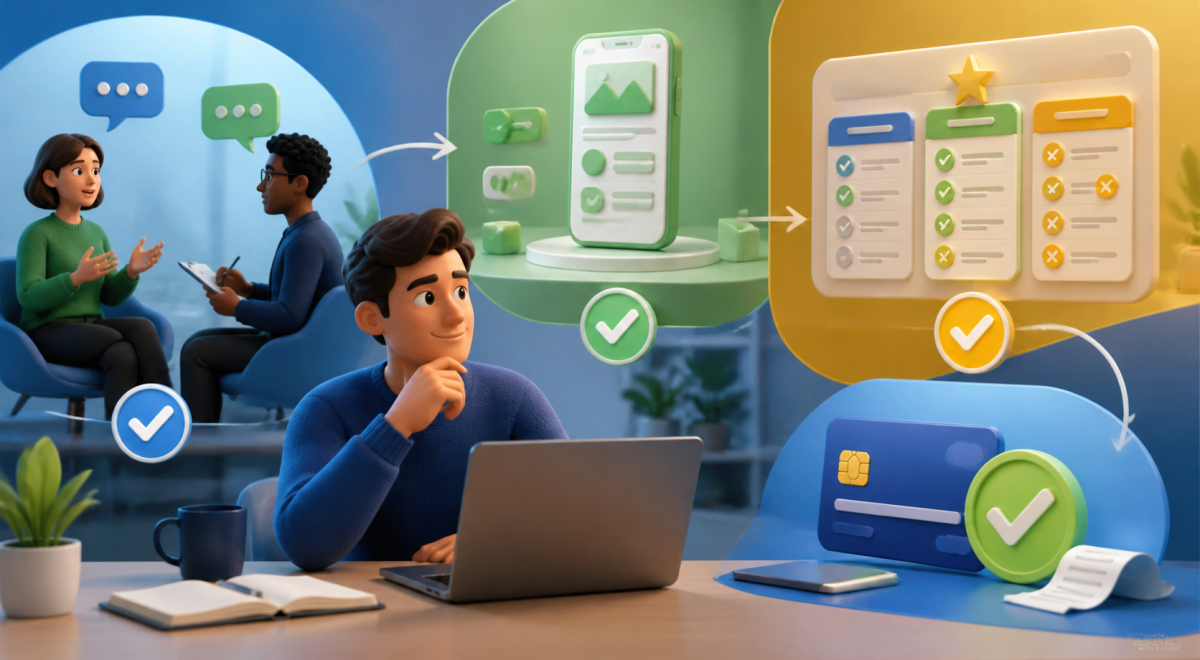
A business idea can sound excellent and still fail to attract paying customers. Validation reduces uncertainty before you commit substantial money, time, inventory, or development effort.
Define the Problem Clearly
Describe the customer, situation, problem, and desired outcome in plain language. A specific problem is easier to research and test than an idea designed for everyone.
Interview Potential Customers
Ask how people handle the problem today, how often it occurs, what it costs, what they tried, and who decides to buy. Avoid asking only whether they like your idea.
Study Existing Alternatives
Review competitors, manual workarounds, and the option of doing nothing. Compare audience, price, strengths, complaints, and gaps. Your idea needs a meaningful reason to be chosen.
Create the Smallest Useful Test
Test the central promise without building the complete business. A service can begin with a manual pilot, a product with a prototype, and a course with a live workshop. Be honest about what exists.
Ask for Real Commitment
Compliments are weak evidence. Stronger signals include a deposit, preorder, paid pilot, scheduled demonstration, or a customer investing time to test the solution. Explain all terms clearly.
Set Decision Criteria
- Repeated evidence of the same problem
- Relevant customers willing to test or pay
- Realistic delivery cost and margin
- Manageable risks and dependencies
- A clear reason customers prefer the solution
Conclusion
Start with the customer problem, study alternatives, build the smallest honest test, and look for real commitment. Spending a little to learn can prevent spending a great deal on an assumption.
Set Evidence-Based Decision Rules
Before testing, write down what evidence would justify continuing, changing direction, or stopping. For example, require a minimum number of qualified interviews, a repeated urgent problem, and several people willing to take a meaningful next step. Avoid choosing thresholds after seeing the results because that makes weak evidence look convincing.
Document What You Learn
Keep a simple validation log with the date, customer type, assumption tested, method, observation, and next decision. Separate direct quotes and measurable behavior from personal interpretation. At the end of each test cycle, summarize what became more certain, what remains unknown, and the cheapest experiment that can reduce the next important uncertainty.
A clear record also protects the team from repeating failed experiments or relying on one memorable conversation. Validation is complete enough to invest further when several independent signals point in the same direction and the remaining risks are affordable to test.